A school fair teaches kids that not all the money collected from sales is profit. In this exercise, students subtract expenses from revenue to find the profit and explain the result.
A small project with a big question
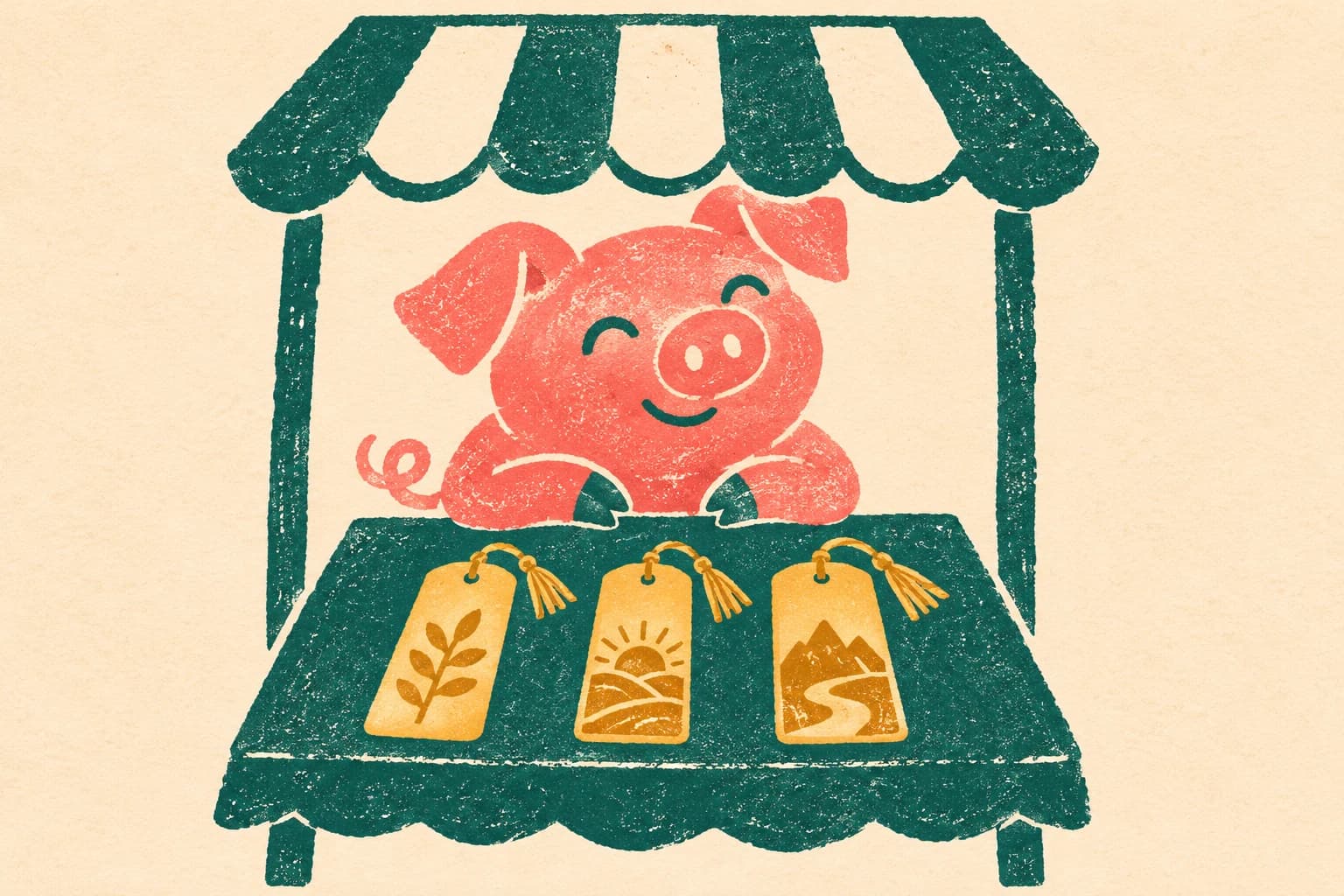
At a school fair, a bookmark stall can teach a clearer lesson than a page of definitions: what did it cost us to get ready, and what was left after the sale? This Pigi project is designed for students around ages 10–14. You can run it as a classroom simulation or as a school-approved activity. It doesn’t require families to bring money or buy their children’s products.
In Albania, Junior Achievement’s “Student Companies” program gives high school students hands-on entrepreneurship experience. Our project is shorter and aimed at younger students; it is neither a substitute for that program nor an official module of it. The useful connection is the idea of working with a product, making decisions together, and keeping clear money records.
School fair ideas: one product and four roles
Choose something simple, such as bookmarks made from reused cardboard. Set the time, materials, and maximum number of products before work begins. Assign four roles: making the product, recording expenses, presenting, and checking the accounts. Rotate the roles so that one student isn’t always decorating while another is always doing the numbers.
For a real fair, the school decides on permissions, supervision, how the money is kept, and what it will be used for. For a simulation, use paper coins and imaginary buyers. Record donated materials separately: “donated” doesn’t mean worthless. The simplified calculation below counts only the project’s stated expenses; discuss time and the use of equipment as resources that exist even when no one pays for them.
The example that separates sales from profit
The class makes 20 bookmarks. Cardboard and decorations cost 600 lek in total. The price is 50 lek per bookmark. If 16 sell, revenue is 16 × 50 = 800 lek. After subtracting 600 lek in expenses, 200 lek is left. That is the project’s profit in our simplified calculation, not the 800 lek in the cash box.
Four bookmarks are left unsold. We don’t count them as money earned, and we don’t promise they’ll sell later. If only 10 sold, revenue would be 500 lek and the result a loss of 100 lek. If 12 sell, revenue equals the 600 lek cost: the project neither gains nor loses. That’s the break-even point. These variations open a discussion without labeling the group that sold less a “failure.” The numbers show the project’s result, not the students’ worth.
What can we change without breaking the exercise?
Once groups have made their predictions, change just one condition. For example, materials cost 100 lek more, while sales stay at 16 bookmarks at 50 lek each. Profit falls to 100 lek. Ask what they might plan differently next time: less waste, a simpler product, or a few questions beforehand to check whether buyers are interested. Raising the price is an option to discuss, not the automatic answer.
Keep cash donations separate from sales. If someone gives 200 lek without taking a product, that’s not bookmark revenue. Likewise, money put in at the start to buy materials isn’t profit. These distinctions keep the class from adding every amount into one column and reaching the wrong conclusion. Use a table with the date, a description, money in, and money out.
Wrapping up: the explanation matters more than the sales record
At the end, ask each group for three sentences: what we predicted, what happened, and what we would change. Assess the accuracy of the calculation, the record-keeping, and the teamwork. Don’t link grades to how much parents bought or to a family’s ability to contribute. A group that finds and corrects a mistake has done valuable work.
At the end of the lesson, ask: “We collected 900 lek from sales and spent 650 lek. How much is left?” The answer is 250 lek, but ask students to explain the subtraction too. A student who can say why the 900 lek can’t be called profit has understood the key idea. You can then connect the project to budgeting or to your classroom economy.
Common questions
Do we need real money?
No. A simulation with prices and paper coins teaches the difference between revenue and profit without asking families to pay.
Is this the official JA program?
No. It’s a simplified Pigi project. The JA program is mentioned as an Albanian example of hands-on entrepreneurship learning.
How do we handle unsold products?
Record them as leftover products, not as money received. Discuss how they could be used, without assuming they’re sure to sell later.