A good financial literacy lesson plan for elementary school targets one measurable skill: using play money, students compare two options and explain their choice within a budget. The game becomes a lesson when it ends with reflection and a short exit ticket.
A lesson that starts with math and leads to everyday life
A student can add up four prices correctly and still not understand why they can’t buy everything. Financial literacy gives the math a purpose: there is a limited amount, there are several needs and wants, and a choice has to be made. The lesson becomes clearer when students also explain what they left for later.
This financial literacy lesson plan is a practical proposal for teachers, not an approved curriculum. You can link it to addition, subtraction, comparison, reasoning, and teamwork, depending on your class objectives. For grades 1–3, the Bank of Albania, the country’s central bank, offers the “Derrkuci Çufo” (Çufo the Piglet) package, which is also designed for cross-curricular projects. Mentioning it does not mean that Pigi is a partner of the Bank or that our material has been endorsed by it.
What research supports and what to observe yourself
A meta-analysis of experiments by Kaiser and colleagues finds that, on average, financial education improves financial knowledge and behavior. That does not mean every game produces the same result in every classroom. So plan a short learning check as well, not just a fun activity.
Before the lesson, choose one objective: “By the end of the lesson, the student chooses purchases within a limit and explains one alternative they set aside.” Keep the same objective even if you change the numbers or materials. That way, the activity doesn’t turn into simply coloring in banknotes.
Preparation: what you need
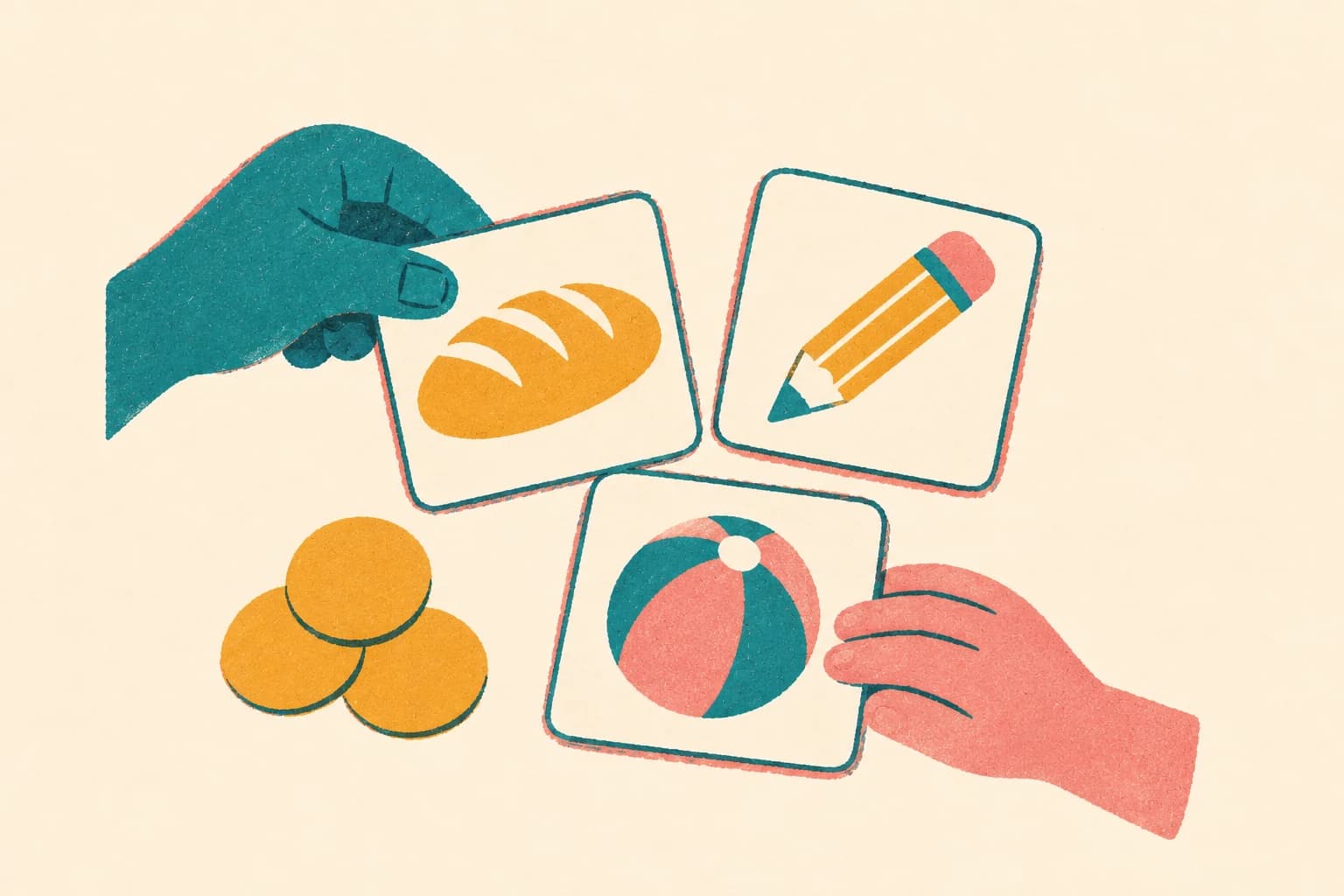
For each group, prepare an envelope of play money, four product cards, and a sheet with three columns: “We have,” “We spend,” and “Left over.” Hand-drawn materials work fine. No phones, personal accounts, or money from home are needed.
Use only made-up prices and make that clear to students. For example, a group has 500 play lek. The cards show a notebook for 120, a pencil for 80, a ball for 350, and stickers for 100. The task first asks for a notebook and a pencil for an imaginary character who is getting ready for school. That leaves 300. The ball doesn’t fit the budget; the stickers do, but the group may also decide to save the money.
Assign roles: reader, calculator, recorder, and explainer. Let the roles help each other, and rotate them in the next round so the same student isn’t always holding the pencil.
A 45-minute financial literacy lesson, minute by minute
Adjust the timing to your class’s pace. If the opening discussion runs long, drop a game round, but keep the wrap-up: that’s where you hear students’ reasoning.
- 0–5 minutes: introduce the character, the amount, and the two needs. Each student makes an individual prediction.
- 5–10 minutes: model one purchase and how to record it. Show how to check the amount left.
- 10–25 minutes: groups choose, calculate, and record. Ask for a reason behind each choice.
- 25–35 minutes: change one condition; for example, the ball’s price drops to 280 play lek. Groups review their plan without erasing their first decision.
- 35–42 minutes: two groups present different solutions. Discuss how both can be reasonable.
- 42–45 minutes: each student completes one sentence and one calculation on an individual exit ticket.
One activity, three levels
In grades 1–3, use just a few products, large pictures, and numbers students already know. Instead of 500 play lek, you can work with ten paper tokens. Let students show their choice with objects or explain it out loud.
In grades 4–6, add making change, comparing two package sizes, and a short written reason. A student who calculates quickly can look for a second solution instead of taking over the group’s work. In grades 7–9, you can use unit prices, a percentage discount, or a delivery cost. Ask students to compare what an ad promises with the final price. Keep every scenario hypothetical, and never ask for information about parents’ accounts.
Check understanding and keep every student included
An exit ticket can have three blanks to fill in: “We had __. After buying, we had __ left. We chose __ because __.” Then ask what changed when the price changed. Assess calculation errors and reasoning separately. Note whether each student identifies the limit, calculates the total, and gives a reason. Don’t grade how much money they saved: in one scenario, spending on a need is the most sensible choice; in another, waiting makes more sense.
Revisit a similar situation a week later with new numbers. That tells you more than asking “Did you like the game?” Give every group the same starting amount, don’t ask how much money students get at home, and avoid any public comparison of wealth. For students who struggle with reading, use icons and read the instructions aloud; for those who need more time, use fewer cards.
As a follow-up at home, ask for a conversation, not a purchase: “Find two ways to spend an afternoon, at least one of them free, and explain what each one requires.” That way, taking part doesn’t depend on a family’s ability to spend.
Albanian research, too, should be read in light of who was studied. Nano and Istrofor examined the link between parental income and financial literacy among 637 university students in Albania. The study offers context on inequality; it does not measure children in 9-year school (grades 1–9), nor does it prove that income determines any individual student’s ability.
Common questions
Should we do this only during Global Money Week?
No. You can use it as a short activity throughout the year and come back to it with new objectives. If you’re planning an event tied to the campaign, check that year’s dates separately.
Can I use real money?
Play money and paper tokens are all this plan needs. They avoid costs, lost money, and visible differences between families.
Is this lesson part of a ministry-approved program?
No. It’s a Pigi proposal for teachers to adapt to their class. Institutional resources are linked for further reading and preparation.