Money games for kids work best when they’re short and use paper money: a pretend shop, choosing between two wishes, finding a mistake on a receipt, or a picnic on a budget. Practice one skill each time, and stop before the game turns into a test.
Getting ready for money games at home: ten minutes and some paper
You don’t need an expensive kit for these money games. Paper, a pencil, and a few things from around the house are enough. For young children, use large pieces of paper rather than coins or small objects they could put in their mouths. Match the numbers and prices to how far your child can count.
The CFPB (the U.S. Consumer Financial Protection Bureau) lists counting and sorting among early money activities. The games below are our suggested versions for home, not a tested program or a promise that your child will instantly become good with money. Pick one activity and end with a question: “What did you notice?” If your child loses interest, pick it up another day. Setting up should take less time than playing.
1. The three-item shop
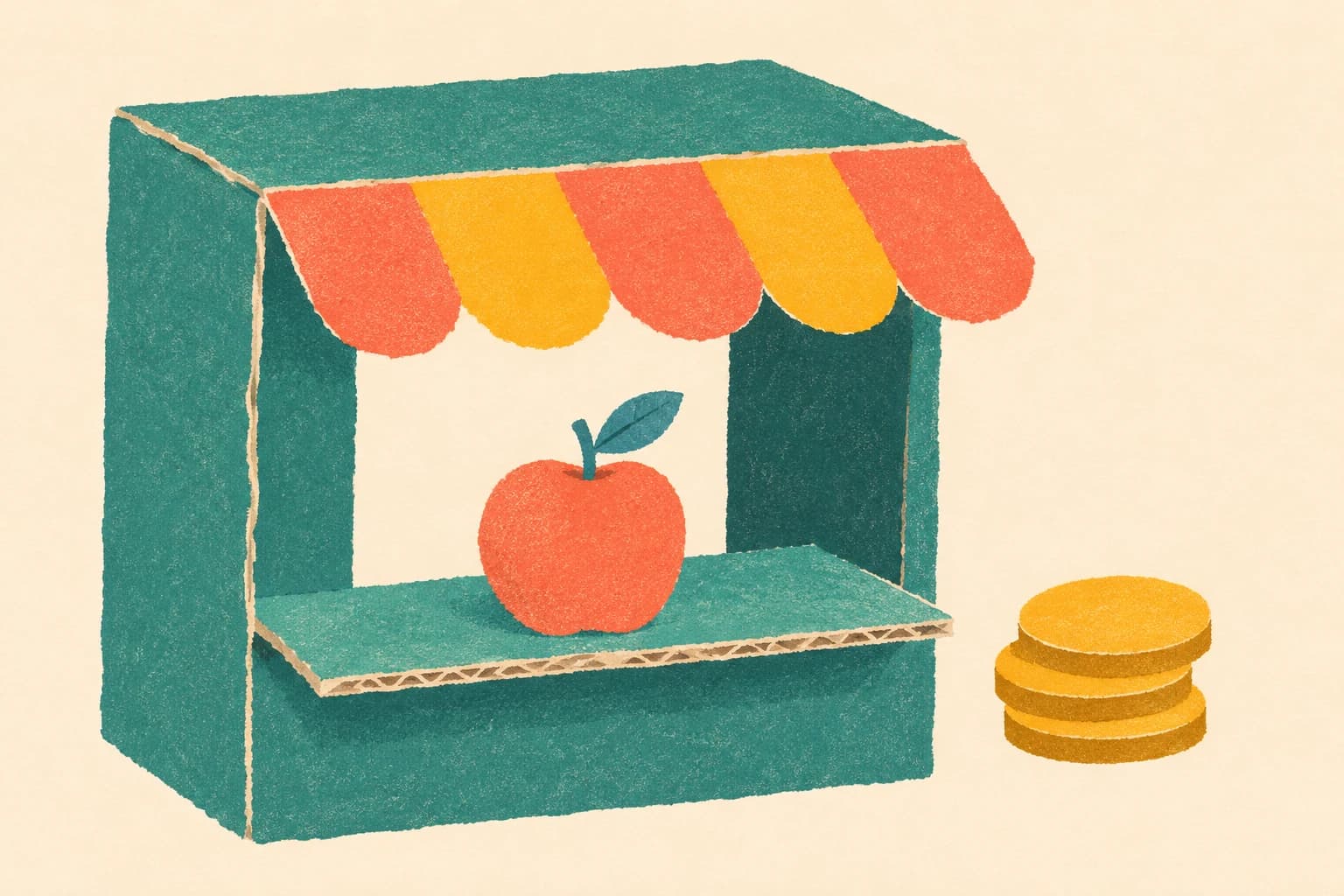
Set out a book, a toy, and a pencil. To start, use play prices of 1, 2, and 3 units. Give the buyer five paper tokens worth 1 each. Your child chooses, pays, and sees what’s left. Then switch roles between customer and shopkeeper.
If your child knows bigger numbers, use pretend prices of 50, 100, and 150 lek. Paying for the 150-lek item with a 200-lek note means getting 50 lek in change. Make it clear that the paper notes are game pieces, not money to use outside the house. End by asking, “How did you check that you had enough?” Don’t add discounts, borrowing, or interest in the same round; one well-understood purchase is enough.
2. Two wishes, one choice
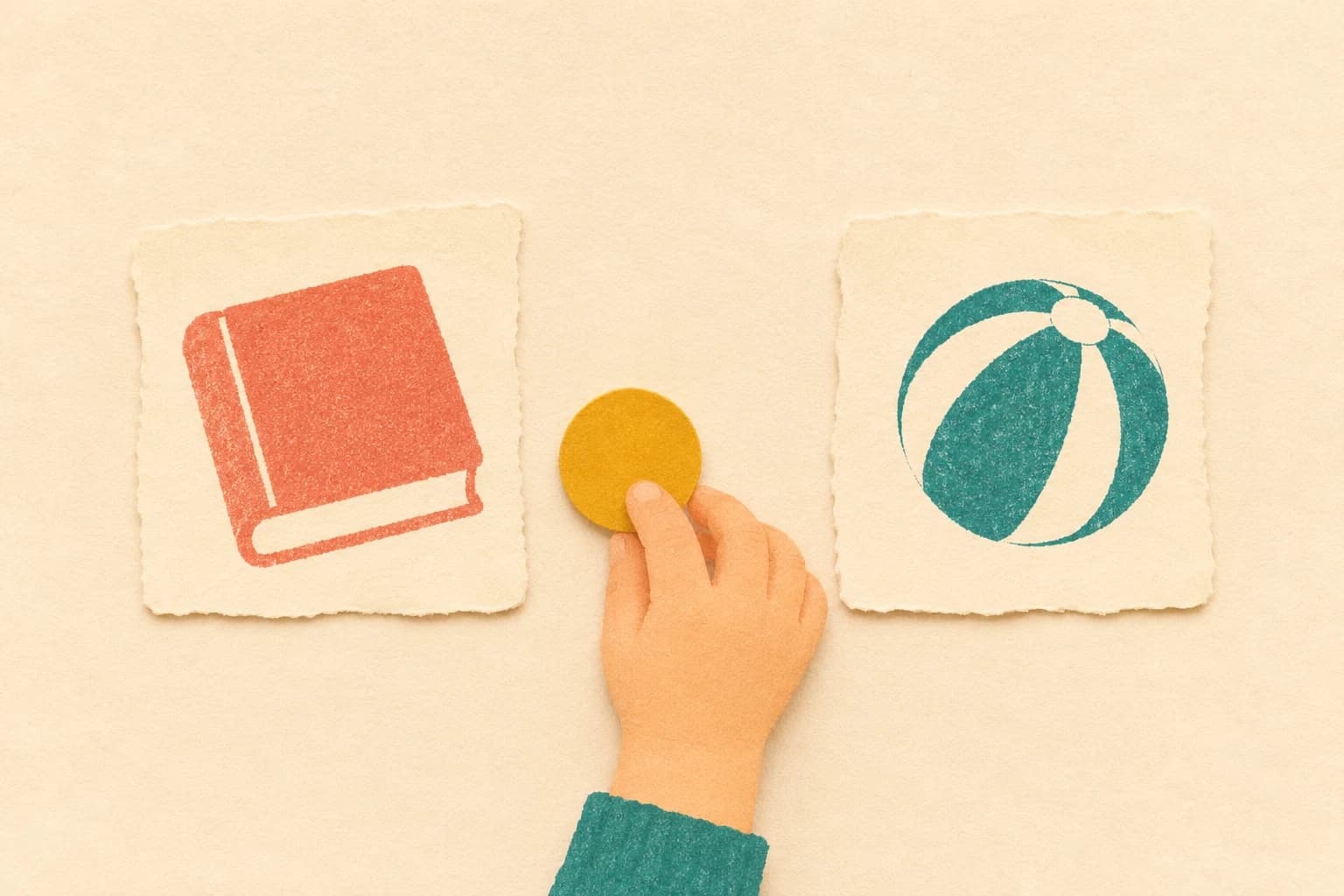
Draw two things your child would like in the game, such as a ball and a book. Each costs five units, and your child has only five. Let them choose and explain why, without suggesting that one choice is nobler than the other.
In the next round, they might buy neither and keep their tokens. That’s a valid choice too, but it shouldn’t always earn more praise than a well-thought-out purchase; the game is about reasoning, not guessing the answer a parent wants. Ask, “What did you leave for later when you chose this?” That makes the option not chosen visible without turning it into a loss or a punishment.
3. The receipt with a mistake
Write down two items with pretend prices of 40 and 60 lek, but put the total as 120 lek. Say up front that this is a play receipt with a mistake you added on purpose. Your child checks the math and corrects the total to 100 lek.
Then switch roles: your child makes a receipt, correct or with a mistake, and you check it. Don’t let the game send the message that shopkeepers are cheats; the point is that even numbers someone else gives us are worth reading carefully. For children just learning addition, use 2 + 3. For more confident ones, add quantities: two notebooks at 40 lek each make 80 lek.
4. The picnic with a budget
Draw four food options for a pretend picnic and give them simple prices. Set a budget that allows some combinations, but not all of them. Plan together what to take and how to check the total.
Keep it a planning game, not a test where your child has to give up real food. At an actual picnic, the adults provide suitable food, keeping the whole family’s needs in mind.
In a public discussion on the UK parenting forum Mumsnet, some parents mention the example adults set and everyday conversations about choices. These are personal experiences, not research or expert consensus. They can give you ideas for questions, but not rules for your family.
5. A story with three endings
Make up a character who gets ten play units. In the first ending, they spend them on something they’ll use. In the second, they save some for a goal. In the third, they use some to help someone. Ask your child what might happen next in each story.
There’s no need for an ending where the saver is always the good guy and the spender the bad one. Money serves different purposes, and the right choice depends on the situation. Your child can even invent a fourth ending.
For materials in Albanian, the Bank of Albania’s page for students offers educational resources, such as a teaching package featuring Çufo the piglet. It’s a separate resource; our games are not materials approved by the Bank. Keep the drawings and come back to the game when your child asks to keep going.
Common questions
What ages are these money games for?
Adapt them to how well your child counts and understands. Start with a few units and a single choice; add change only once the basics are clear.
Should the winner get real money?
No. There’s no need for a winner or a payment. The goal is for your child to practice making a decision and explain it in their own words.