Allowance for siblings doesn’t have to be the same amount: compare what the money covers, not just how much each child gets. Rules should be easy to understand, consistent, and open to review.
“Why does he get more?” deserves an answer
In a family with two children, when siblings get different allowances, a bigger amount can look like bigger love. Before you answer “because he’s older,” explain what each child’s money has to cover. Age can shape responsibilities, but on its own it doesn’t explain every difference.
The American Academy of Pediatrics (AAP) notes that age, maturity, and temperament affect how children experience conflict. When it comes to family money, that’s one more reason to listen to each child without making one the yardstick for the other. A child who complains shouldn’t be labeled jealous.
You could say: “We cover what you both need. This amount is different because it also includes another expense. Let’s look at it together.” If you can’t explain the difference clearly, the agreement may need another look.
Separate needs from money for personal choices
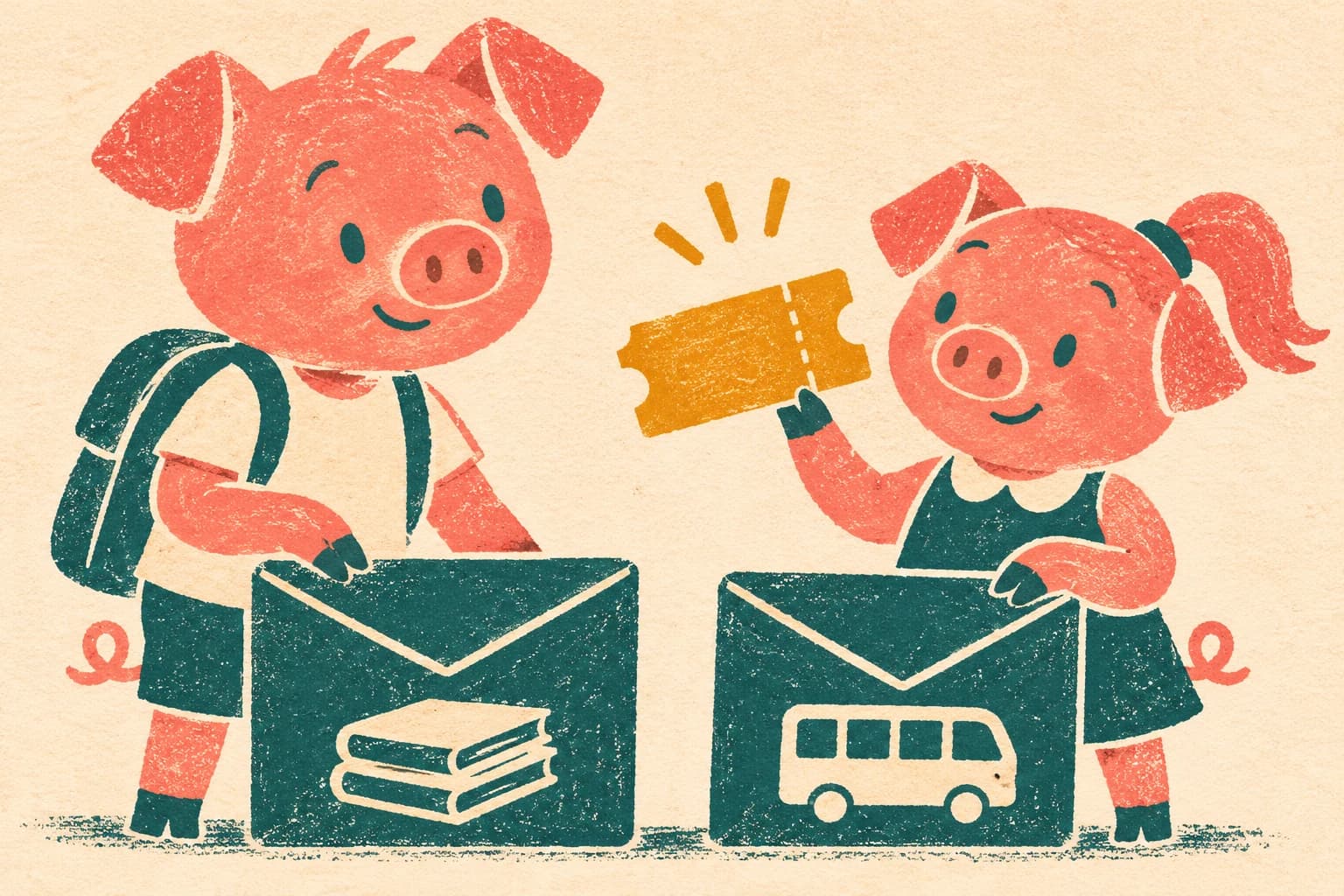
In a made-up example, a 13-year-old gets 1,000 lek a week, but 600 lek of it is for planned bus fares. That leaves 400 lek for personal choices. A 9-year-old gets 400 lek a week for personal choices, while a parent pays for transportation directly. The cash in their hands looks different, but the room for wants is the same.
This isn’t a formula every family should follow. Some families will choose different amounts for wants too, depending on age and budget. The example simply shows why comparing 1,000 to 400 tells you little until you see what each amount includes.
For each child, write down three things: what the parent pays directly, what the child is trusted to pay, and what’s left for personal choices. Learning to budget should never put a safe trip home from school at risk. If a responsibility is still too hard, the parent keeps it or gives more support.

Allowance for siblings: the same process, not necessarily the same amount
The process can be shared: the amount is set for a known period, changes are explained, and requests are reviewed on a set day. Children should know they can ask questions without being mocked, and that an outburst doesn’t automatically change the agreement.
A meta-analysis on parents’ differential treatment of siblings looks at links with differences such as age and gender, and at how that treatment is measured. It doesn’t offer an allowance table for Albanian families, so it would be wrong to draw an ideal amount or a universal rule from it.
In practice, don’t tie money to comparisons like “your sister is better at this.” If you’re teaching planning, compare each child’s progress with their own previous attempt. One child may need a shorter planning period or more visible reminders; that’s support, not a verdict on whether they can be trusted.
Gifts and loans between siblings need limits
One child’s birthday gift doesn’t mean the other must immediately get the same amount. Explain the occasion, and don’t turn every celebration into balancing the books. If relatives regularly give in a way that leaves one child feeling left out, the adults should talk about expectations among themselves.
It’s just as important not to turn the family saver into a mandatory bank. If one child has spent their share, the other shouldn’t be forced to hand over theirs. Sharing willingly, with a clear agreement, is very different from having money taken without permission.
With young children, it’s simplest to avoid loans between siblings altogether. With older kids, if you allow a small arrangement, help them agree on the amount and when it will be paid back. Don’t let a debt become a way to pressure each other.
A ten-minute check-in with no scoreboard
Every few weeks, check whether responsibilities have changed. A new activity, a different route to school, or a new need may call for an adjustment. Don’t keep an amount unchanged just to avoid the conversation.
Each child can share what worked, what was hard, and what they’d like to try next time. If the topic is sensitive, start with one-on-one conversations. Then share only the rule that applies to everyone, without reading one child’s personal purchases aloud in front of the other.
A good agreement won’t make every complaint disappear. But it gives your child an answer they can understand: needs are covered, differences have reasons, and every child has the right to be heard. Love isn’t measured by what’s in the envelope.
Common questions
Should children of the same age get the same amount?
It can be a simple starting point, but look at what the amount covers and at each child’s actual needs. Explaining the process matters as much as the number itself.
Should the sibling who saved have to give money to the other?
Not as an obligation to cover the other child’s spending. Personal money isn’t taken without permission; a voluntary gift is a different matter.
How do we talk about it when the family’s finances change?
Calmly explain the new rule to everyone it affects. No child should be made to feel to blame for the change or responsible for the adults’ budget.